
Formal–Natural Front Yard Garden Design in Richmond Hill | Layered Planting for Year-Round Interest
- Junning Wang
- Sep 5, 2025
- 3 min read

Updated: Oct 28, 2025
Balancing formal order and natural flow, this Richmond Hill front yard garden offers privacy, shade solutions, and seasonal beauty.

Project Background
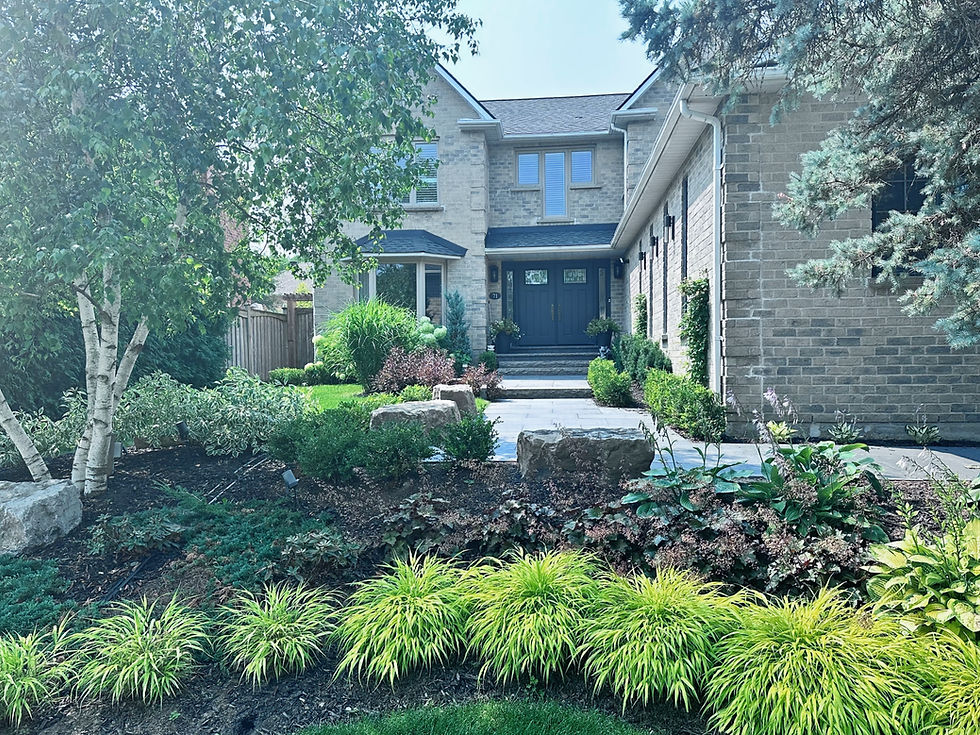
This project is located in Richmond Hill, right next to the entrance of a community park. The front yard offers a generous space, but the client requested a garden that combines the order of a formal design with the softness of natural layering. The goal was not to merge the yard with the park but instead to emphasize its independence and unique character.

The property faces northeast, with theoretical full sun exposure, but shading from a large maple tree at the park entrance and additional trees on the east side makes the site primarily part shade. Sunlight is available from about 10:30 a.m. to 3:00 p.m., though unevenly. The yard sits slightly lower than street level, with the entrance on the left side and a young Japanese Maple already positioned as a natural focal point.
Several healthy existing plants were kept or transplanted into the new layout:
A 10-foot Japanese Maple ‘Bloodgood’
Three neatly trimmed Hicks Yew
Several Hosta ‘Fire and Ice’
A few Red Barberry
Garden Zoning

The design divides the front yard into four distinct zones, each with a specific function and planting strategy:
1. Narrow Planting Bed by the Front Door
This slim bed already featured three Hicks Yew as structural anchors. We added Hydrangea ‘Incrediball’ in between and created a neat low hedge at the edge. Instead of traditional Boxwood—heavily impacted by boxwood moth in the GTA—we used Inkberry Holly, which can also be shaped into a hedge and provides the same formal effect.
2. Focal Planting Bed near the Driveway
Three key focal points define this area:

The existing Japanese Maple ‘Bloodgood’
PG Hydrangea Standard
Blue Spruce Standard
Around the Hydrangea Tree, a three-layer composition was created with Blue King Siberian Iris, Violet Blazing Star, and North Wind Switchgrass, echoing its vertical form. Near the Blue Spruce Std, we combined Phlox and Creeping Juniper ‘Nana’ as groundcovers, suppressing weeds while enhancing the Spruce’s presence. Globe Cedar and Mugho Pine (5-gallon size) were added as mid-level evergreens, to be shaped through pruning into calm, formal forms.
3. Privacy Planting along the Park Fence
This zone focuses on winter interest. Along the rear fence, we planted Ivory Halo Dogwood and Red Twig Dogwood:
In summer, they serve as a green backdrop to flowering perennials.
In winter, their brilliant red stems add striking contrast against the snow, creating the classic image of “a touch of red in a field of white.”
In front, their tones connect visually with the cool blues of Blue Spruce and the deep greens of Hicks Yew.
4. Privacy Planting at the Garden Entrance
At the entry, Purple Leaf Sandcherry was chosen for its affordability, resilience, and distinctive foliage, making it a long-standing favorite in borders.
Under the shade of the existing Maple Tree, we planted Blue Angel Hosta—which can reach 4–5 feet across—and Bugloss (Brunnera). Their darker foliage provides contrast to the brighter focal areas while filling shady gaps, creating a smooth visual transition.
Perspective Views
The design considers how the garden is experienced from different vantage points:
From the driveway: the composition highlights the Hydrangea Tree as the focal point, layered against the Japanese Maple, their heights forming a balanced structure.
From the perspective of arriving home or leaving: the Blue Spruce Standard takes center stage, surrounded by evergreens and a ground layer of Phlox, offering a calm, grounded scene.
Seasonal Scenes
Summer: a vibrant mix of blooms, full of energy and texture.
Autumn: the Japanese Maple transforms into fiery tones of red and orange, the strongest seasonal accent.
Winter: Red Twig Dogwood provides striking color against the snow, while evergreens maintain their structure—creating the image of “a splash of red in a white canvas.”
Conclusion
Through the method of “focal points – layering – balance – lighting,” this project achieves a careful equilibrium between formal order and natural flow. Within a front yard that might otherwise feel exposed, the design establishes privacy, seasonality, and multi-perspective enjoyment, embodying the principle of finding calm within complexity.


Comments