
Plant Profile: Winterberry for GTA Garden

Afterglow, Red Sprite, Jim Dandy & classic red winterberry

In a GTA winter, most shrubs fade into the background—leaves drop, and we’re left with bare twigs and fence lines. Winterberry holly (Ilex verticillata) does the opposite. Once the leaves fall, the berries become the main show, turning simple branches into strings of colour that stand out against snow, mulch, and wood.
For us, winterberry is one of our most-used shrubs for winter interest in residential projects across Toronto and the GTA—often right alongside red- and yellow-twig dogwoods and low evergreen structure. Whenever a client asks for “four-season planting” rather than “just summer flowers,” winterberry almost always enters the conversation.
What Winterberry Looks Like (and Why It Works Here)
Winterberry is a deciduous holly native to eastern North America. Instead of keeping its leaves through winter, it drops them and lets the berries carry the scene.
Across the seasons it shifts like this:
Spring–summer – fresh green foliage; visually calm, easy to use as a backdrop
Fall – leaves warm into yellow and bronze tones
Late fall–winter – leaves drop and the stems are covered in bright berries
With snow on the ground, those berries read almost like built-in seasonal décor. Against cedar fences, brick, dark mulch, or stone, they give the whole planting bed a focal point when most other plants have gone quiet.
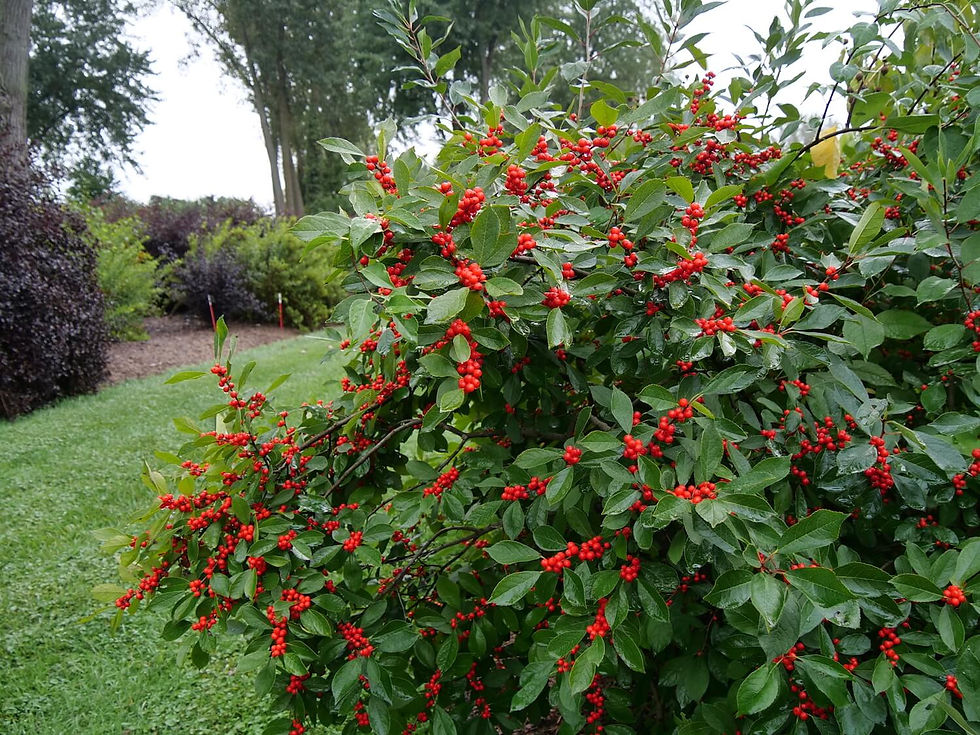
The Cultivars We Reach for Most Often
There are many winterberry cultivars on the market. In practice, around Toronto we keep coming back to a small group that nurseries reliably carry and that behave well in residential gardens.
Red Sprite – compact and bold
Red Sprite (often misspelled as “Red Spirity”) is a compact female cultivar with a dense, rounded shape and big, bright berries packed along the stems.
Size – roughly 3–4' tall, 3–5' wide
Habit – low, rounded, easy to keep tidy
Best used – front of mixed beds, along paths, near low walls and patios
When we want strong winter colour without blocking windows or views, Red Sprite is usually our first pick.
Afterglow – middle height with warm-toned berries
Afterglow sits in the mid-height range and is very comfortable along fences and at the back of planting beds.
Size – typically around 4–6' tall in GTA gardens
Berry colour – warm orange-red to red, softer than a neon fire-engine red
Best used – as a background shrub behind lower evergreens and perennials, or in back corners of the yard
Its warmer berry tone pairs nicely with brick, cedar, and warm outdoor lighting.
Classic red winterberry – easy hedge and backdrop
Many nurseries also stock generic red winterberry without a specific cultivar name. These are usually medium to large shrubs, often in the 5–8' range, with strong red fruit and a more upright habit.
Best used – informal hedging, soft screens along fences, transitions into more natural edges at the back of the property
Effect – a loose, natural “background wall” with enough height to frame the yard without feeling heavy
In narrow city lots, a row of these can create a gentle sense of enclosure and strong winter colour at the same time.
Jim Dandy – the essential (but quiet) pollinator
There’s one important detail with winterberry:
You need both male and female plants for a good berry display.

Red Sprite, Afterglow, and most of the classic red forms are female—they carry the berries.Jim Dandy is the male pollinator we most often pair with them:
Doesn’t produce berries itself
Compact enough to tuck quietly into a corner or back row
Provides the pollen that allows nearby female plants to set a heavy crop
In our planting plans we usually:
Label female plants clearly, and
Add one Jim Dandy within effective range (roughly 1 male to 5–7 females, depending on spacing).
Most homeowners never notice which shrub is doing the pollinating—they just see a line of plants covered in berries and enjoy the view.
The main differences are final height and overall mass, which is why in design we choose cultivars based on the size of the space and how tall we want the “background layer” or hedge to be.
Visually, most winterberry cultivars read almost the same in the landscape: fine branching, bare stems in winter, and bright berries covering the twigs.
Design Roles: Soft Background + Easy Hedge
In our projects across Toronto and the GTA, winterberry tends to fall into two main roles: a soft background board and a low-maintenance hedge.
1. A soft background layer with boxwood and ornamental grasses
Because winterberry is relatively full and often medium-tall, we rarely use it as the first row. It works much better as a background layer:
Back row – winterberry (Afterglow or a classic red form)
Middle row – boxwood, inkberry, or other small evergreen shrubs
Front row – Japanese forest grass, low ornamental grasses, or other low perennials
You’ll see this structure in both front foundation planting and backyard patio borders:
Evergreen shrubs hold the line and give structure
Grasses and perennials provide seasonal movement and texture
Winterberry steps in during late fall and winter to “turn the lights on”
From the street or patio, the planting reads as layered and soft instead of flat against the house or fence.

2. Along fences and at the back of the yard: a natural hedge
Winterberry is also very comfortable as a loose, natural hedge:
It doesn’t need to be clipped into a perfect box—its natural outline already feels soft
Planted in a row, it provides a modest sense of privacy without becoming a heavy wall
In winter the berries transform a simple hedge into a strong seasonal feature
We often use it:
Along the back fence in rear yards
On one or both side fences where views need softening
With a band of grasses or lower shrubs in front to visually soften the fence itself
From inside the house or from the patio, you see a gently layered background with structure and colour, not just a straight line of boards.
Light, Site and Soil in the GTA
From a practical point of view, winterberry is quite forgiving, but there are conditions where it really shines:
Light
Full sun to part sun both work
For heavier fruit set and stronger colour, we favour full sun where possible
In many city backyards, the fence line ends up in bright part shade; winterberry usually handles that well
Soil
Prefers moist, slightly acidic soil
Tolerates our typical clay as long as the site isn’t constantly waterlogged
Works well around the edges of rain gardens, low spots, or slow-draining corners
Climate
Very cold-hardy and well-suited to Toronto winters
Handles freeze–thaw cycles better than many trendier shrubs
Availability and Budget in the GTA

From a design–build perspective, winterberry is also attractive because it’s easy to source and budget-friendly:
Commonly available in local nurseries in 3-gallon and 5-gallon sizes
Priced competitively compared to many “fashionable” shrubs
Flexible enough to use in front yards, side yards, and rear yard screening without blowing the plant budget
That makes it much easier for us to recommend winterberry as a repeat element across multiple projects where winter interest is a priority.
Care Notes We Share with Homeowners
For homeowners, winterberry care usually comes down to a few simple points:
Watering – regular deep watering in the first 1–2 seasons during hot, dry spells; after establishment it’s relatively low-maintenance
Pruning – light shaping only; avoid heavy pruning after flower buds have formed if you want a strong berry display
Feeding – in most residential gardens, a yearly layer of compost or a light, balanced fertilizer in spring is enough
Pollination – at least one compatible male (often Jim Dandy) in the planting plan is essential for consistent fruit
The real “work” happens at the design stage: matching cultivar size to the space, pairing male and female plants correctly, and choosing the right location in terms of light and moisture.
Why Winterberry Keeps Showing Up in Our Designs

For residential landscapes in Toronto and the GTA, winterberry ticks a lot of boxes at once:
Native background and well-adapted to local climate
Strong winter interest exactly when most gardens are quiet
Multiple sizes—from compact Red Sprite to mid-height Afterglow and taller red forms—for different spaces
Works beautifully as both a soft background layer and a natural hedge
Budget-friendly and easy to find in local nurseries
As planting palettes across the GTA shift toward more resilient, climate-appropriate, four-season combinations, winterberry is one of those shrubs that feels both practical and beautiful. It’s easy to explain to homeowners—no complicated story needed. One look at a hedge full of bright berries on a snowy day is usually enough.


Comments